treasury shares
Definition
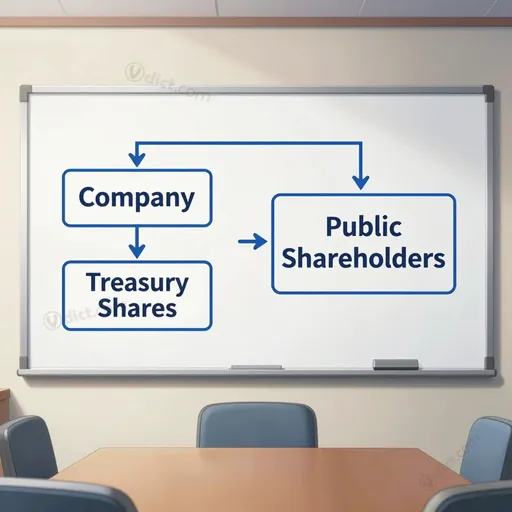
Noun (plural: treasury shares) 1. Capital stock repurchased by the issuer: Shares of a company's own stock that have been issued to the public in the past but were subsequently bought back by the company itself. These shares are held in the company's treasury and are not considered part of the outstanding shares available to the public.
Usage
Treasury shares are a specific category of stock on a company's balance sheet. They are acquired through a share repurchase (buyback) program. Once repurchased, these shares lose certain rights and are not included in key financial calculations.
Examples
- The board authorized the repurchase of up to one million shares, which will be held as treasury shares.
- The company's earnings per share increased after it retired a portion of its treasury shares, reducing the total number of shares outstanding.
- Treasury shares can be reissued to the public at a later date or used for employee compensation plans.
Advanced Usage
- Accounting Treatment: Treasury shares are recorded as a contra equity account, reducing total shareholders' equity on the balance sheet.
- Non-Voting and Non-Dividend: While held in the treasury, these shares do not have voting rights and do not receive dividends.
- "Issued but not outstanding": This is a key technical description. The shares were formally issued, but after being repurchased, they are no longer counted among the outstanding shares used to calculate metrics like market capitalization or earnings per share.
Variants and Related Words
- Treasury stock: A synonymous term, commonly used in U.S. accounting and financial contexts.
- Share buyback / Stock repurchase: The action a company takes to acquire its own shares from the market, which results in treasury shares.
- Outstanding shares: The shares currently held by all shareholders, excluding treasury shares.
- Retired shares: Treasury shares that have been permanently cancelled by the company and cannot be reissued.
Synonyms
- Treasury stock
- Reacquired shares
- Buyback shares (informal)
Key Distinctions
- Treasury shares vs. Unissued shares: Unissued shares were never sold to the public, while treasury shares were issued, sold, and then bought back.
- Treasury shares vs. Outstanding shares: Outstanding shares are actively held by investors and have full rights; treasury shares are held by the issuing company and have no rights.
Noun
-
stock that has been bought back by the issuing corporation and is available for retirement or resale; it is issued but not outstanding; it cannot vote and pays no dividends
Khám phá thêm
Các từ liên quan
Từ đồng nghĩa